We can see that the transformation global trade has undergone over the past few years is changing not only logistics operations, but also the way production and supply chains are structured. The disruptions that began with the pandemic, the Russia-Ukraine war, security issues along the Red Sea and Suez route, the tensions currently surrounding the Strait of Hormuz, and increasing geopolitical risks are forcing companies to reconsider supply models they had previously relied on without question.
The impact of this on the logistics sector is quite tangible
The lengthening of routes in maritime transportation between the Far East and Europe, increasing transit times, and continued pressure on capacity are driving freight rates upward while also weakening the predictability of supply chains. In an environment where transit times on the East-West corridor can increase by 30–40%, the need for greater vessel and container capacity to carry the same trade volume also directly affects the supply-demand balance.
Today, the high costs and long transit times experienced in transportation from China to the Mediterranean are among the most visible consequences of this transformation. However, in my view, the key question is not how much further freight rates will rise.
The real question is:
Because what we are experiencing represents far more than an ordinary period of rising logistics costs. Companies are no longer looking solely for the lowest-cost supplier or the shortest transportation route. The resilience of the supply chain, the availability of alternatives, the predictability of delivery times, and how quickly it can be reorganized in times of crisis are becoming increasingly important.
This is also strengthening the trend toward Nearshoring, in other words, relocating production and sourcing closer to primary markets.
This Is Exactly Where the Opportunity for Türkiye Begins
When sourcing from the Far East takes longer and costs more for a European manufacturer today, alternatives in closer geographies naturally come back into consideration.
Türkiye has significant advantages in this regard.
Our geographical proximity to the European market, strong manufacturing infrastructure, advanced road transportation capacity, ports, air cargo infrastructure, and developing railway connections are important factors that could transform Türkiye from merely a transit point between East and West into a regional supply and distribution hub.
However, we need to be realistic here. Türkiye has not automatically transformed this opportunity into a competitive advantag
Particularly in recent years, increases in production costs, especially labor costs, financing conditions, and exchange-rate fluctuations can limit Türkiye’s cost advantage in certain areas of manufacturing. Geographical proximity to Europe is an important advantage; however, we should not forget that global companies do not base their investment and sourcing decisions solely on distance.
For a manufacturer to choose Türkiye, the total supply chain cost must be competitive with alternatives in the Far East.
Therefore, it would not be accurate to view the opportunity ahead of Türkiye solely through the lens of “geographical advantage.” The real issue is whether we can support our geographical proximity with cost competitiveness, speed, predictability, quality, and logistics flexibility.
To the extent that we can achieve this, Türkiye’s attractiveness for Nearshoring can become sustainable.
For this reason, I also believe that it is no longer sufficient to describe Türkiye’s logistics position simply through the concept of a “bridge.”
The opportunity ahead of Türkiye is not merely to become a country through which goods pass, but to become a hub where goods are produced, stored, consolidated, and distributed to Europe.
However, to achieve this, we must first ensure that global companies can receive a convincing answer to the following question:
I believe this will be the critical question in the period ahead
Indeed, the fact that some Middle Eastern cargo is being transported by road due to the current challenges in maritime transportation, that ports such as Iskenderun and Mersin are gaining greater importance as alternative transit points, and that railway options along the Middle Corridor are increasingly being considered demonstrates how quickly the logistics system can adapt.
Türkiye’s advantage in terms of Nearshoring does not stem solely from geography.
Its 30-year Customs Union relationship with the European Union has already made Türkiye
an important part of European value chains. The fact that total trade volume between
Türkiye and the EU reached USD 233 billion in 2025 clearly demonstrates the scale of this
economic integration.
Today, as global companies diversify their supply chains, rather than creating entirely new manufacturing geographies from scratch, they seek to move toward regions where established industrial and commercial ecosystems are already strong. Türkiye’s existing economic integration with Europe represents an important advantage in this respect.
However, it is also clear that we should not rely solely on our geography if this advantage is to be transformed into lasting competitiveness.
Stronger railway connections, improvements in port capacity and connectivity, faster border crossings, greater digitalization of customs procedures, lower logistics costs, and deeper commercial integration with Europe in a manner aligned with today’s economic realities are all necessary.
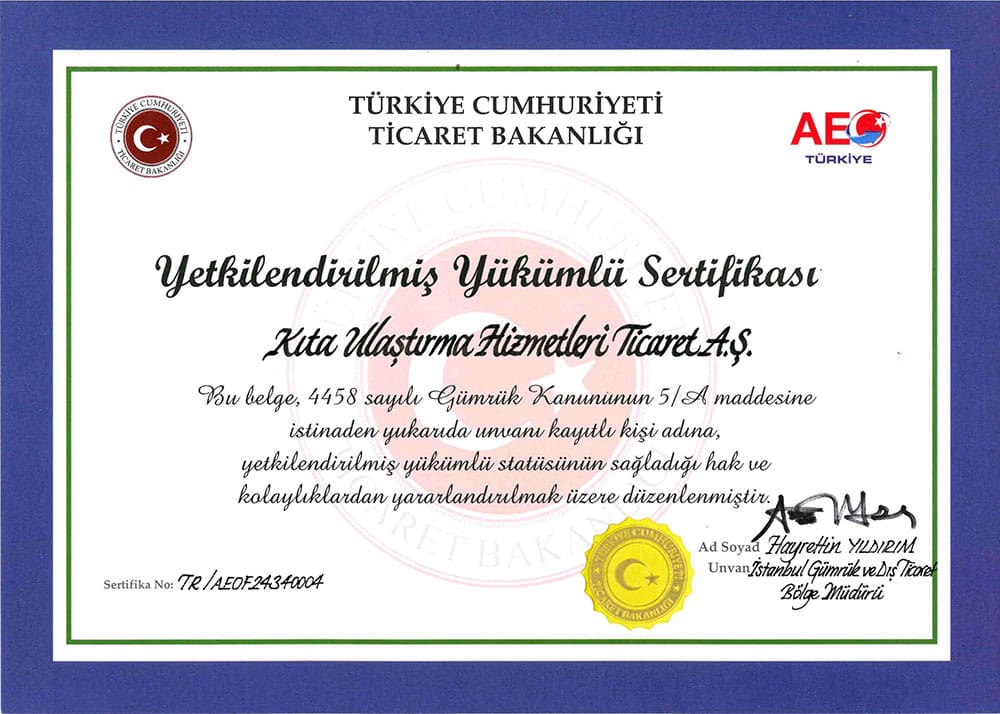
I believe the steps taken in this area recently are important. The agreement reached between the EU and Türkiye in July on the mutual recognition of Authorized Economic Operator statuses represents tangible progress in terms of customs cooperation and supply chain security.
These developments may not create a major transformation on their own. However, we should not forget that competitive advantage in the trade system of the future will be built through the cumulative impact of such connections.
Nearshoring should not be viewed solely as bringing factories geographically closer together.
Bringing production centers closer also requires engineers, managers, technicians, sales teams, logistics professionals, and business partners to be able to move more quickly.
For this reason, the issue of visa liberalization in Türkiye’s relations with Europe should also be considered within a broader framework in terms of our economic competitiveness.
Türkiye has fulfilled 66 of the 72 criteria under the Visa Liberalisation Roadmap; the remaining six criteria focus on the implementation of the readmission agreement, protection of personal data, operational cooperation with Europol, judicial cooperation, GRECO recommendations, and counter-terrorism legislation.
Completing these criteria will mean more than simply facilitating travel.
From the perspective of a company trading with Europe, easier and more predictable human mobility can directly affect many layers of the economic relationship, from meetings with new customers and the establishment of manufacturing facilities to enabling technical teams to reach sites and developing business partnerships.
Therefore, visa liberalization should be viewed not only from the perspective of tourism or individual travel, but also as an economic facilitator that can strengthen Türkiye’s integration into European value chains.
Reducing barriers to mobility in our economic and commercial relations with Europe could also strengthen the advantages Türkiye offers in terms of Nearshoring.
Every disruption occurring in global supply chains today may be creating an opportunity for Türkiye.
However, there is an important difference between an opportunity and a lasting competitive advantage.
An increase in cargo moving through Türkiye due to a crisis may provide a temporary advantage. The real success will be ensuring that companies continue to choose Türkiye even after the crisis has ended.
Moreover, this competition is not taking place solely between Türkiye and the Far East. At a time when production and supply chains are being repositioned, Türkiye is also competing with Eastern Europe, North Africa, and other nearby regions.
Therefore, what Türkiye needs to do is not merely benefit from the cost differentials created by crises, but strengthen its own structural competitiveness.
Achieving this requires a holistic approach spanning logistics infrastructure, digitalization, customs processes, railway investments, manufacturing capacity, and qualified human resources.
Because today, simply saying “Türkiye is close to Europe” is not enough for a company to bring its supply chain closer to Türkiye.
The company must also be able to receive positive answers to the following questions:
How quickly can I deliver my product to Europe?
How predictable is that timeframe?
What will my total supply chain cost be?
Do I have alternative transportation options?
How fast are my customs procedures?
How resilient is my supply chain in the face of a crisis?
And perhaps most importantly:
I believe Türkiye’s position on the new trade map will be shaped by the answers we provide to these questions.
In the new era of global trade, companies no longer want to remain dependent on a single country, a single supplier, or a single logistics corridor. They are seeking to build supply chains that are closer, more flexible, and more secure.
Türkiye has a significant opportunity ahead of it, created precisely by this transformation.
However, to capitalize on this opportunity, rather than waiting for crises to redirect business towardTürkiye, we must create today the conditions that will make Türkiye a preferred hub.
Perhaps the question we need to ask in the period ahead is no longer: “Can Türkiye become a logistics bridge?” But rather:
“How indispensable a hub can Türkiye become within the new supply chains of global companies?”
I believe this is exactly where Türkiye’s real story on the new trade map begins
With Love and Respect,
Emre Eldener
Vice Chairman of the Board
Kıta Logistics

We provide agile, tailor made solutions for your most challenging and complex logistics operations!
| Cookie name | Active |
|---|---|